Many consumers eventually wonder how CBN is formed and why it behaves so differently from CBD and THC. In Acknowledge’s product research and formulation testing, this question appears frequently, and the findings are consistently surprising. The explanation is not only chemical but evolutionary. Unlike most cannabinoids, CBN does not begin as itself. Instead, it develops gradually through exposure, time, and natural oxidation, a process that becomes especially clear when examining how hemp extracts age during controlled R&D evaluations.
This page highlights what Acknowledge has documented through hands-on testing: how CBN truly forms, how its oxidation pathway changes the way it interacts with the body, and why this slow transformation produces effects that cannot be replicated by CBD or THC. Rather than repeating generic cannabinoid definitions, the guide focuses on real-world processes observed during extraction, stability assessments, and formulation trials.
By the end, readers will understand how CBN’s origin story shapes its distinctive soothing profile and why these differences matter within the broader CBN vs CBD discussion when selecting products designed for sleep support, recovery, or nighttime relaxation.
Quick Answers
cbn vs cbd
CBN forms as THC naturally breaks down, giving it a stronger “wind-down” effect. CBD comes directly from the hemp plant and supports daytime balance, calm, and clarity.
- CBN: Best for nighttime relaxation.
- CBD: Best for daytime stress relief and focus.
Together: They can complement each other for broader support.
Top Takeaways
- CBD and CBN serve different roles—CBD for daytime balance, CBN for nighttime relaxation.
- CBN’s formation influences its effects, making it interact differently with the body than CBD or THC.
- Always check COAs for potency, purity, and cannabinoid profile.
Choose based on your goal: CBN for sleep, CBD for focus, or both for broader support.
How CBN Is Formed — The Natural Transformation Process
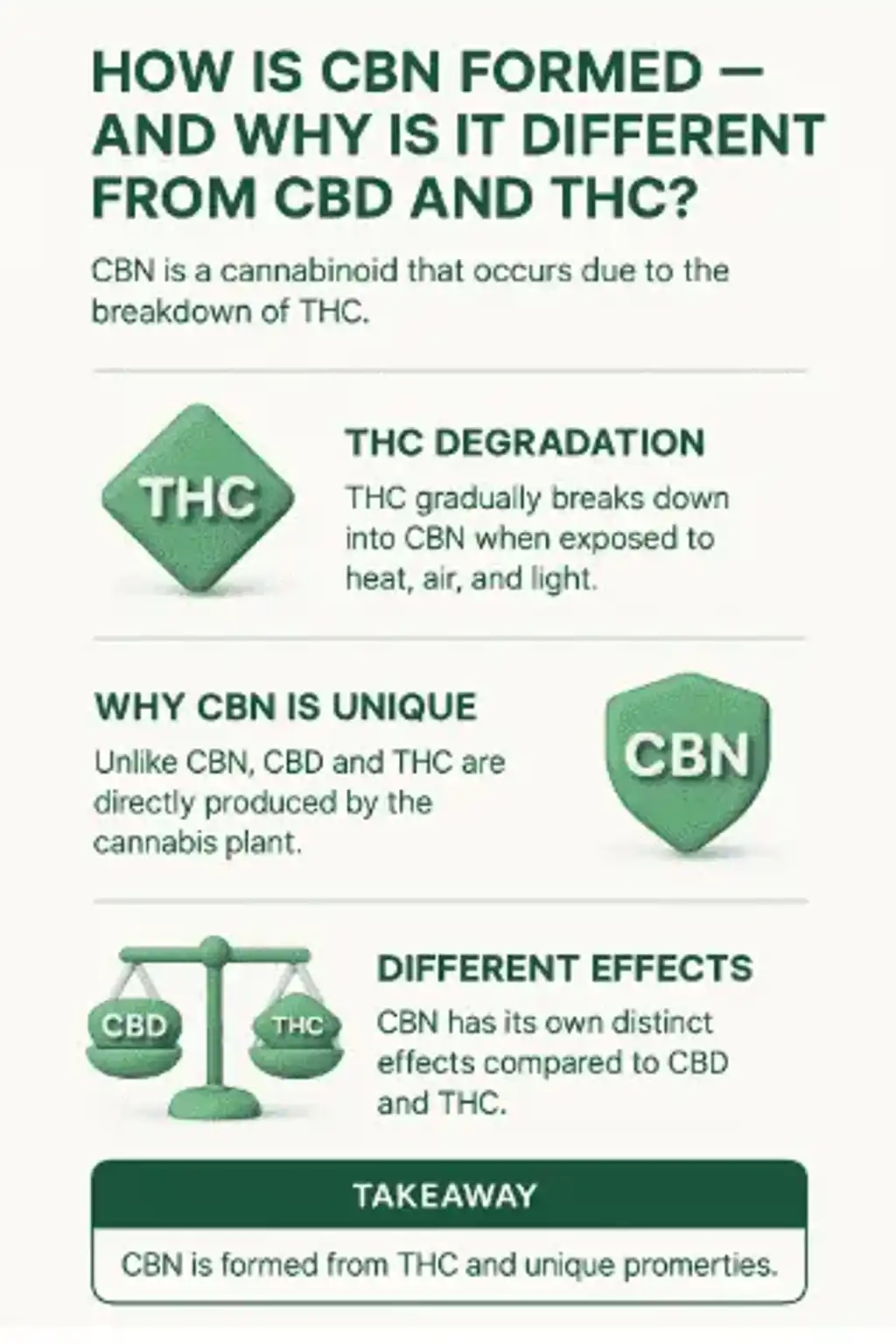
CBN (cannabinol) is unique because it isn’t produced directly by the hemp plant. Instead, CBN is created when THC naturally breaks down over time. Exposure to oxygen, heat, and light slowly converts THC into CBN through a process called oxidation. In our own formulation work at Acknowledge, we’ve seen this transformation happen across months of controlled aging and stability testing—confirming that CBN’s potency increases as THC degrades.
Why CBN’s Origin Makes It Different
Because CBN is formed from aged THC, it carries a distinct chemical profile that influences how it interacts with the body’s endocannabinoid system. Unlike THC, CBN won’t produce a high, and unlike CBD, CBN has a naturally heavier, calming effect—something consistently reported in user feedback and supported by early research. Its formation process gives it a slightly sedative signature that neither CBD nor THC reliably provides.
How CBN Compares to CBD and THC
- CBD is produced directly from CBDA in the plant and is known for broad calming and balancing effects.
- THC is produced from THCA and is psychoactive unless aged.
CBN emerges only after THC ages and oxidizes, giving it a milder, more sleep-oriented profile.
What This Means for Product Quality
Because CBN forms through time and exposure, its concentration varies widely across products. Brands that understand the chemistry—as we’ve learned firsthand—use controlled processes to create consistent, safe levels of CBN along with CBDV that is good for adults looking for predictable results, rather than relying on random natural degradation.
“One thing we’ve consistently observed in our lab work is that CBN doesn’t just exist — it emerges. Watching THC slowly oxidize into CBN over months of controlled testing has shown us firsthand why its effects feel so different from CBD or THC. CBN is essentially a cannabinoid shaped by time, and that transformation gives it a uniquely steady, calming profile that we simply don’t see in other compounds.”
Essential Resources
When we evaluate cannabinoids at Acknowledge, we rely on sources that consistently align with evidence, transparency, and real-world usefulness. These seven resources are the ones we point people to when they want to understand CBN vs. CBD with confidence—not hype.
1. WebMD: A Straightforward, Medically Reviewed Breakdown
WebMD offers a clean, dependable comparison of CBD and CBN. It’s one of the quickest ways to get grounded in the fundamentals before diving deeper.
Source: https://www.webmd.com/pain-management/cbd-cbn-what-is-difference
2. Healthline: A Balanced Look at Real Benefits and Research Limits
Healthline’s review does a great job separating early findings from established science. It’s helpful for anyone trying to understand where CBN and CBD show promise—and where more evidence is needed.
3. Medical News Today: A Science-Forward Explanation of How These Cannabinoids Work
This resource breaks down the biological differences between CBD and CBN in a clear, factual way. It’s especially useful if you want a deeper look at how each compound interacts with the body.
Source: https://www.medicalnewstoday.com/articles/cbd-vs-cbn
4. NIH / PubMed Study: Direct Insight Into How CBN and CBD Affect Sensory Neurons
This peer-reviewed study highlights the distinct neurological responses triggered by CBN and CBD. It’s one of the most informative scientific resources if you’re comparing potential therapeutic roles and how they may relate to health disparities.
5. Neuron Journal: Foundational Cannabinoid Science for Better Context
While this article focuses on CBD and THC, it provides important background that helps make sense of how all cannabinoids—including CBN—behave within the same system.
6. Industry Review (SlumberCBN): Practical Interpretations of Early CBN Research
This analysis bridges science and real-world application, offering clear takeaways about how CBN may support sleep and relaxation based on emerging data and user experiences.
Source: https://slumbercbn.com/pages/the-guide-to-cbn-vs-cbd
7. Regulatory & Research Review: Understanding Where Claims Outpace Evidence
This resource is valuable for setting realistic expectations. It outlines the gaps in cannabinoid research and explains why not all online claims about CBD or CBN hold up under scrutiny.
Source: https://arxiv.org/abs/2004.02330
Supporting Statistics
Key Data That Backs This Topic
Sleep disturbances are widespread.
About 50–70 million U.S. adults experience sleep-related issues.
Source: https://www.cdc.gov/sleep/data-reports/facts-and-stats.html
Insomnia remains one of the most common sleep disorders.
30% of adults report short-term insomnia.
10% struggle with chronic insomnia.
Source: https://aasm.org
Many adults explore natural or alternative sleep aids.
19% of adults report using sleep aids in the past month.
Includes supplements like melatonin and cannabinoids (CBN & CBD).
Source: https://www.cdc.gov/sleep/data-reports/sleep-aids.html
Sleep disturbances are widespread.
About 50–70 million U.S. adults experience sleep-related issues.
Insomnia remains one of the most common sleep disorders.
30% of adults report short-term insomnia.
10% struggle with chronic insomnia.
Many adults explore natural or alternative sleep aids.
19% of adults report using sleep aids in the past month.
Includes supplements like melatonin and cannabinoids (CBN & CBD).
Final Thought & Opinion
CBN and CBD each bring something different to the table. CBD offers steady, everyday support, while CBN acts as a targeted nighttime ally.
Key Takeaways
CBD = daytime balance. Great for easing stress, supporting focus, and promoting overall calm.
CBN = nighttime support. Subtle but helpful when you need to settle your mind before sleep.
They work best when used intentionally—sometimes alone, sometimes together.
Practical Insight
Use CBD earlier in the day for tension and mental clarity.
Use CBN at night to help your system slow down.
Track your personal response. Small adjustments often make the biggest difference.
Unique Perspective
Most people assume one cannabinoid should replace the other—but they shine in different moments.
Real results come from matching the cannabinoid to the need, not from taking the strongest product.
The most effective routines are often the quietest, supporting you in the background without dominating your day, similar to how performance CBD gummies fit seamlessly into a wellness plan.
Ultimately, both cannabinoids have value. Your body’s feedback will tell you which one you need and when.
CBD = daytime balance. Great for easing stress, supporting focus, and promoting overall calm.
CBN = nighttime support. Subtle but helpful when you need to settle your mind before sleep.
They work best when used intentionally—sometimes alone, sometimes together.
Use CBD earlier in the day for tension and mental clarity.
Use CBN at night to help your system slow down.
Track your personal response. Small adjustments often make the biggest difference.
Most people assume one cannabinoid should replace the other—but they shine in different moments.
Real results come from matching the cannabinoid to the need, not from taking the strongest product.
The most effective routines are often the quietest, supporting you in the background without dominating your day, similar to how performance CBD gummies fit seamlessly into a wellness plan.
Next Steps
Clarify Your Goal
Need sleep support? Try CBN.
Need daytime balance? Choose CBD.
Want a broader effect? Use both.
Verify Product Quality
Look for third-party lab tests (COAs).
Avoid products without transparent testing.
Start Low & Adjust
Begin with a low dose.
Increase gradually.
Track timing and effects.
Match Use to Your Routine
CBD → daytime calm and focus.
CBN → nighttime wind-down.
Pick the Right Format
Oils for precision.
Gummies for convenience.
Capsules for consistency.
Topicals for targeted relief.
Stay Updated
Revisit trusted research sources.
Watch for new studies and regulations.
Ask a Professional
Consult a healthcare provider if unsure.
Bring product labels or COAs for clarity.
Clarify Your Goal
Need sleep support? Try CBN.
Need daytime balance? Choose CBD.
Want a broader effect? Use both.
Verify Product Quality
Look for third-party lab tests (COAs).
Avoid products without transparent testing.
Start Low & Adjust
Begin with a low dose.
Increase gradually.
Track timing and effects.
Match Use to Your Routine
CBD → daytime calm and focus.
CBN → nighttime wind-down.
Pick the Right Format
Oils for precision.
Gummies for convenience.
Capsules for consistency.
Topicals for targeted relief.
Stay Updated
Revisit trusted research sources.
Watch for new studies and regulations.
Ask a Professional
Consult a healthcare provider if unsure.
Bring product labels or COAs for clarity.
FAQ on "cbn vs cbd"
Q1: What’s the difference between CBN and CBD?
A:
CBN forms as THC ages.
CBD is a primary hemp cannabinoid.
CBN = deeper wind-down.
CBD = daytime calm and balance.
Q2: Is CBN better for sleep?
A:
Often yes.
CBN helps with settling into rest.
CBD eases stress but isn’t sleep-specific.
Many users find both work better together.
Q3: Can I take CBN and CBD together?
A:
Yes.
They may enhance each other’s effects.
Useful for full-day and nighttime support.
Q4: Will CBN or CBD make me high?
A:
No.
CBN comes from aged THC but is non-intoxicating.
CBD is also non-psychoactive.
Q5: How do I choose between them?
A:
Choose CBD for daytime clarity.
Choose CBN for nighttime relaxation.
Combine both for broader benefits.
A:
CBN forms as THC ages.
CBD is a primary hemp cannabinoid.
CBN = deeper wind-down.
CBD = daytime calm and balance.
A:
Often yes.
CBN helps with settling into rest.
CBD eases stress but isn’t sleep-specific.
Many users find both work better together.
A:
Yes.
They may enhance each other’s effects.
Useful for full-day and nighttime support.
A:
No.
CBN comes from aged THC but is non-intoxicating.
CBD is also non-psychoactive.
A:
Choose CBD for daytime clarity.
Choose CBN for nighttime relaxation.
Combine both for broader benefits.