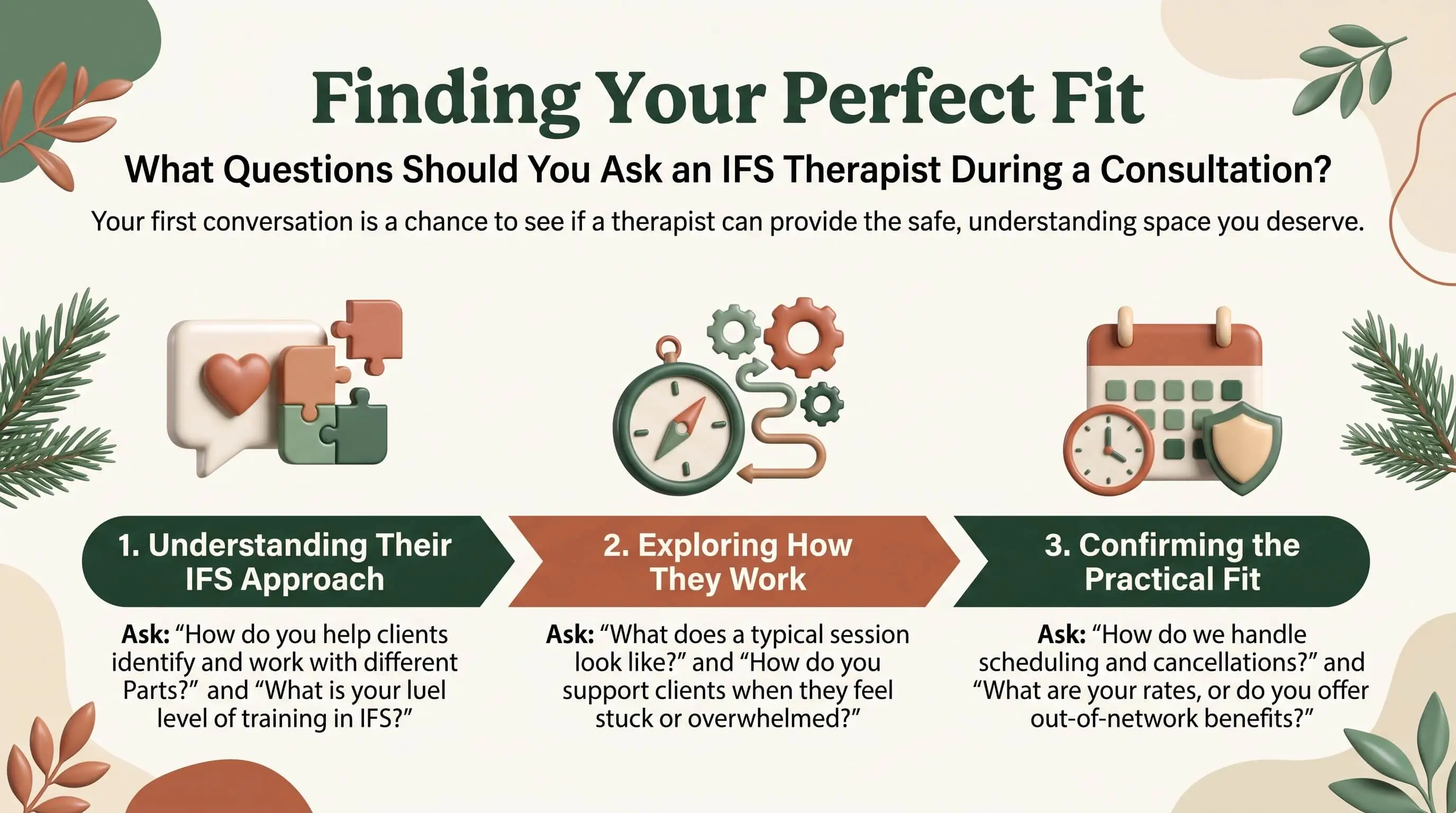
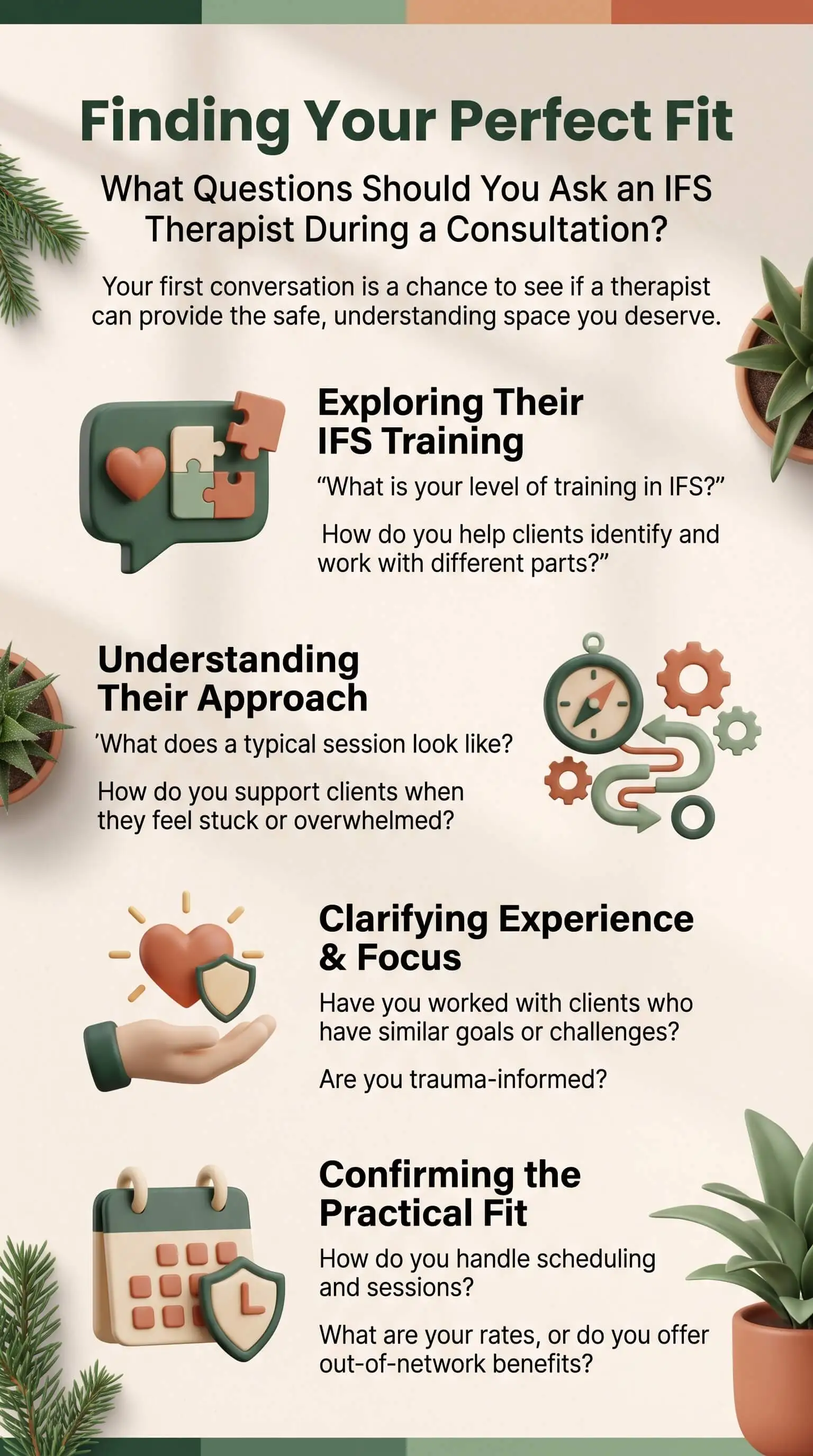
Here's what goes in it. Ask an IFS therapist about their training, their license, how they pace the hard parts, what a session actually looks like, who they don't work with, and what it costs. If you're looking for an IFS therapist in Washington State, add one more: can we meet online from wherever I am in the state?
The list is the easy part. Telling a good answer from a smooth one takes a bit more practice.
Plenty of men grew up hearing that needing help meant something was wrong with them. Some learned the hard way that doctors don't always listen. Both are good reasons to interview a therapist carefully, especially if you want IFS therapy explained before deciding whether it's right for you, and neither is a reason to cancel the call. Fifteen minutes tells you a lot about a person when you know what to listen for.
TL;DR Quick Answers
IFS Therapist Washington State
Look for a therapist who holds a Washington license, such as an LMHC, LICSW, or LMFT, and has formal IFS training through the IFS Institute. You can confirm the license on the state's Provider Credential Search. A Washington-licensed therapist can see you by video anywhere in the state, as long as you're physically in Washington for each session. Most start with a free 15-minute consultation.
Questions to Ask an IFS Therapist
Ask about their IFS training level, their Washington license, how they pace difficult material, what a session looks like, who they don't work with, and what it costs. Then notice how you feel while they answer. A good therapist welcomes the questions and never rushes you.
Top Takeaways
Training and license are separate questions. IFS training shows they know the model, while a Washington license means they can legally practice therapy.
Pacing gives a lot away. Good IFS work goes slowly and stops when it's too much.
Cultural fit is fair game. Ask directly, and trust honesty over polish.
Online reaches every corner of Washington. You just have to be in the state during sessions.
Bring up cost on the first call. Ask about insurance, self-pay rates, and your written Good Faith Estimate.
What Is an IFS Consultation Supposed to Tell You?
Two things, mostly. Whether this therapist knows Internal Family Systems well, and whether you can picture yourself telling them the truth. The call usually runs about 15 minutes and costs nothing, and you're sizing them up every bit as much as they're getting a feel for you.
Richard Schwartz developed Internal Family Systems around something people already say without thinking. Part of me wants to go. Part of me wants to stay home.
IFS takes that seriously. Each part has a job, usually a protective one it picked up for a good reason, and the work is getting to know those parts from a steadier place inside you that IFS calls the Self. Nobody gets kicked out.
Questions About Training and Licensing
"What IFS Training Have You Completed?"
Ask which level they've reached and how many years they've been using IFS. The IFS Institute runs three levels of training. Getting to Level 3 means finishing Level 1, at least one Level 2, and then Level 3 itself, and certification sits on top of all that as its own separate process.
More hours of training won't guarantee a good fit. A weekend workshop and a well-thumbed copy of No Bad Parts aren't the same thing as training, though, and a good therapist won't flinch when you ask.
"Are You Licensed in Washington, and How Can I Check?"
IFS training doesn't license anyone to practice therapy. In Washington, that takes a state license, usually an LMHC, LICSW, or LMFT, and the therapist should name theirs without a pause.
Then look it up yourself. The Washington State Department of Health's free Provider Credential Search shows whether a license is active and whether the state has ever disciplined that provider. It takes about a minute. I'd do it for anyone on your shortlist.
Questions About How They Actually Work
"What Does a Typical Session Look Like?"
Listen for specifics. How long a session runs, what happens in the first one, whether they'll explain things in plain words as you go. When the answer here is vague, the process usually is too.
"How Do You Pace the Hard Stuff?"
If you only get to one question, make it this one. A strong answer sounds slow on purpose. Nothing gets forced, and when something starts to feel like too much, you stop and stay with what's already in the room. An IFS therapist checks in with your protective parts before going anywhere near what they guard.
I'd be wary of anyone who promises to "get to the root of it" in session one.
"What Happens When a Part of Me Doesn't Want to Be Here?"
Maybe a part of you thinks therapy is soft. Maybe a part of you went quiet the second the call connected. IFS welcomes that part, and a good therapist will get curious about it instead of talking around it. A reluctant part showing up means the model is doing its job, so you haven't done anything wrong.
Questions About Fit and Background
"Have You Worked With People Whose Lives Look Like Mine?"
Ask it straight. About race, faith, money, the neighborhood you grew up in, or being a man who was raised to keep all of this to himself. Plenty of Black men have earned reasons for their trust in the healthcare system to run thin, and a good therapist won't take that personally.
Honesty matters more here than polish. "I haven't worked with many men from your background, so tell me what I'd need to understand" beats a smooth answer that slides right past the question.
"Who Don't You Work With?"
You want a clear answer. Some IFS therapists don't see kids, teens, or couples, and some aren't the right fit for active substance use. That's about fit, and it says nothing about you.
Questions for an IFS Therapist in Washington State About Logistics
"Can We Meet Online Anywhere in Washington?"
Usually, yes. A LFS therapist licensed in Washington state can see you over video whether you live in Spokane, Tacoma, the Tri-Cities, or a small town three hours from the nearest IFS office. You do have to be physically in Washington when you meet, so a trip out of state means rescheduling.
Ask what you'll need on your end. It's usually a device with a camera, a door that closes, and headphones if you own a pair. A parked car counts, and more people use one than you'd guess.
"What Will This Cost, and Do You Take My Insurance?"
Ask which plans they're in-network with and what they charge if you pay yourself. Paying out of pocket entitles you, under the federal No Surprises Act, to a written Good Faith Estimate before your first session. The money shouldn't hold any surprises.
Strong Answers vs. Red Flags
What IFS training do you have?
Strong answer: Names a specific level and how long they've used IFS.
Red flag: Can't name a level, or calls a weekend workshop "certified."
Are you licensed in Washington?
Strong answer: Gives the license type and invites you to look it up.
Red flag: Dodges, or says IFS "doesn't really need" a license.
How do you pace hard material?
Strong answer: Slowly, and you stop whenever it's too much.
Red flag: Promises a breakthrough in the first few sessions.
What if part of me doesn't want to be here?
Strong answer: Welcomes that part and gets curious about it.
Red flag: Tells you to push through or leave your doubts at the door.
Have you worked with people like me?
Strong answer: Answers honestly, including what they'd still need to learn.
Red flag: Brushes the question off or hears it as an accusation.
Who don't you work with?
Strong answer: Names a clear scope and offers referrals.
Red flag: Says they can help with anything.
How long will this take?
Strong answer: "It depends, and here's how we'll keep track."
Red flag: Quotes a fixed number of sessions with no hedging.
"People arrive braced. They're expecting a verdict about what's wrong with them, and instead a part of them gets listened to for the first time in thirty years. Then the whole system exhales. I've watched it happen on a screen from four hundred miles away."
7 Essential Resources
Where to look next, before the call or after it.
Find IFS-Trained Therapists and See Their Level
The IFS Institute's directory filters by state, training level, and certification, and it spells out what each level means. Therapists report their own listings, though, so check the license somewhere else.
Source: IFS Institute Directory
Check a Washington License in About a Minute
Search by name or credential number to see a provider's license type, status, and any disciplinary history. The state updates it daily and treats it as a primary source.
Source: Washington State Provider Credential Search
Search for a Therapist Who Gets Your World
Therapy for Black Men built this directory to help men of color find culturally competent therapists, and you can search it by location and specialty. Use it to start a shortlist or to round out one you already have.
Source: Therapy for Black Men
Ask About Cultural Fit Without It Feeling Awkward
NAMI gives you sample questions for gauging a provider's cultural awareness. It also lists a few to ask yourself afterward, like whether you felt heard and whether the provider treated you with respect.
Source: NAMI: Black/African American Mental Health
Sort Out the Letters After a Therapist's Name
LMHC, LICSW, LMFT, PhD. NAMI explains what each kind of provider trains to do, so you know who you're actually talking to.
Source: Types of Mental Health Professionals
See What Online Therapy Can Cover
The federal telehealth site lists the mental health services that work over video and how to get set up. Worth a look if you've never had a session on a screen.
Source: Telehealth for Behavioral Health Care
Know What Happens If You Reach Out Tonight
If the wait for a consultation feels too long, the 988 Lifeline walks you through what a call, text, or chat is actually like, step by step. It's free and confidential, and someone answers around the clock.
Source: What to Expect From the 988 Lifeline
Finding the right IFS therapy starts with checking a therapist's training, Washington State license, and experience with your specific needs. Resources like the IFS Institute, NAMI, and Therapy for Black Men can help you compare qualifications, understand cultural fit, and explore online therapy options. If you need immediate emotional support, the free, confidential 988 Lifeline is available 24/7.
3 Statistics
The numbers behind why that first conversation matters so much.
Younger Black Men Get Care Less Often When They're Struggling
The CDC's National Center for Health Statistics looked at men aged 18 to 44 who felt anxious or depressed every day. Among non-Hispanic Black and Hispanic men, 26.4% had used mental health treatment, compared with 45.4% of non-Hispanic white men.
About one in four, next to nearly one in two.
Insurance explained much of the gap. Among uninsured men that age, treatment use fell to 12.7%, against 39.3% for uninsured white men.
So when you ask about cost on the first call, you're asking one of the most important questions on the list.
Source: CDC NCHS Data Brief: Racial and Ethnic Disparities in Men's Use of Mental Health Treatments
Most Black Adults With a Mental Illness Go Without Treatment
NAMI, citing federal survey data, reports that only one in three Black adults with a mental illness receives treatment.
Two out of every three are going without.
NAMI names stigma, cost, and provider bias among the reasons, and a free consultation lets you test for that last one before you've spent anything.
Source: NAMI: Black/African American Mental Health
Most of Us Carry Something From Childhood
According to the CDC, about 64% of American adults have reported at least one adverse childhood experience.
Close to two in three people.
IFS assumes the parts that formed around those experiences were trying to keep you safe.
If you're carrying something old, you're in the majority, and a good therapist will treat it that way.
Source: CDC: Fast Facts About ACEs
Final Thoughts and Opinion
The question that tells you the most never gets said out loud. You ask it of yourself while they're answering: how do I feel right now?
Check the credentials, absolutely. Still, a therapist can have every certificate on the wall and leave you feeling processed, like a file being opened. Someone else says "I don't know yet, tell me more," and something in your chest lets go a little. Trust that.
A few things I'd hold onto:
A therapist who rushes the consultant will probably rush the work.
Hearing "I'm not the right fit, but here are some names I trust" is a good therapist being honest with you.
The skeptical part of you that almost didn't book the call deserves a seat. It's been looking out for you a long time.
Being strong and needing someone to listen were never opposites.
Here's an opinion I'll stand behind. For a lot of men, the hardest part of therapy comes before it starts, in those first fifteen minutes when you say out loud that something isn't working. Once the call is booked, you've already done that part. The questions just help you spend the time well.
It also helps to think about what mental health really means when nothing is on fire.
Frequently Asked Questions
Q: Is an IFS Consultation Usually Free?
A: Most IFS therapists offer a short consultation at no charge, often around 15 minutes. It's there so both of you can tell early whether the fit is right. If someone charges for it, ask what you'd be getting.
Q: How Long Is an IFS Consultation Call?
A: Usually 15 to 20 minutes, which is enough for four or five questions and a sense of how they listen. Write your questions down first. Nerves have a way of wiping them the moment the call connects.
Q: Does My IFS Therapist Need to Be Certified?
A: Not necessarily. Certification is an advanced step past the training levels, and plenty of skilled IFS therapists are trained without being certified. A valid state license, real IFS training, and good answers about pacing and fit matter more.
Q: Can I Keep Seeing a Washington IFS Therapist If I Travel Out of State?
A: Generally, no. Therapists can only practice where they're licensed, so you need to be physically in Washington for each session. Plan to reschedule the weeks you're away.
Q: Is IFS a Good Fit for Men Who Don't Like Talking About Feelings?
A: Often, yes. Instead of asking you to produce emotions on cue, IFS asks you to get curious about the parts of you that react and protect. For a man who'd rather not talk about feelings in the abstract, that can be an easier way in.
Q: How Many Sessions Does IFS Usually Take?
A: It depends, and an honest therapist will tell you so. Some people notice a shift within a couple of months, while deeper trauma work moves slower and shouldn't be rushed. Ask how they'll check progress with you along the way.
Q: Does Insurance Cover IFS Therapy in Washington?
A: Often, if the therapist is licensed and in-network with your plan. Insurance pays for therapy, and IFS is simply the approach your therapist uses. Ask which plans they take, and if you're paying yourself, ask for a written Good Faith Estimate.
Q: What If the First Therapist I Talk to Isn't a Fit?
A: Then the consultation did its job. Thank them, ask whether they can recommend anyone, and book another call. Finding the right person can take two or three tries, and that's normal.
Take the First Step
Making the call takes more out of a person than it looks like, and part of you may already be building the case for putting it off. Let it talk. You don't need the right words, and a single sentence is plenty to start.
If you're in Washington and curious what IFS feels like, book a free 15-minute call and bring your list.
If you're in immediate danger, call or text 988, or dial 911.