Most men who land on this page waited a long time to search. The anger started showing up faster, or the same argument kept circling at home. Handling it alone worked for years, right up until it didn't.
If you're in crisis or thinking about hurting yourself, call or text 988. If you're in immediate danger, call 911.
TL;DR Quick Answers
IFS therapist Bellingham WA
Bellingham adults can work with a licensed IFS therapist in person or online. Lauren Rath, MA, LMHC, offers Internal Family Systems therapy to adults in Bellingham and Whatcom County by secure video.
Who it's for: Adults dealing with trauma, CPTSD, anxiety, attachment patterns, perfectionism, or shame.
How it works: You get curious about the parts of you that protect and the parts that hurt, instead of fighting them. Nothing in you is broken.
Pace: You set it. Going slowly is part of the method.
Format: Video only, no Bellingham office. You need to be in Washington during each session.
Insurance: In-network with BCBS, Aetna, Regence, Premera, and Cigna.
Not the right fit for: Depression-focused care, ADHD, or substance use. Expect a referral for those.
First step: A free 15-minute consultation with no forms or obligation.
Before you book anyone: Look up the therapist's license on the Washington State Department of Health Provider Credential Search.
Top Takeaways
Bellingham adults can work with an IFS therapist locally or online with a Washington-licensed clinician.
IFS treats the mind as a set of parts led by a calm core Self, and the work is understanding those parts rather than fighting them.
It suits trauma, anxiety, attachment struggles, perfectionism, and shame. Depression, ADHD, and substance use may need a specialist.
Video sessions cover all of Whatcom County, as long as you're in Washington when you log on.
Two free first steps are a 15-minute consult with a therapist or a call to the NAMI HelpLine.
What IFS Therapy Actually Is
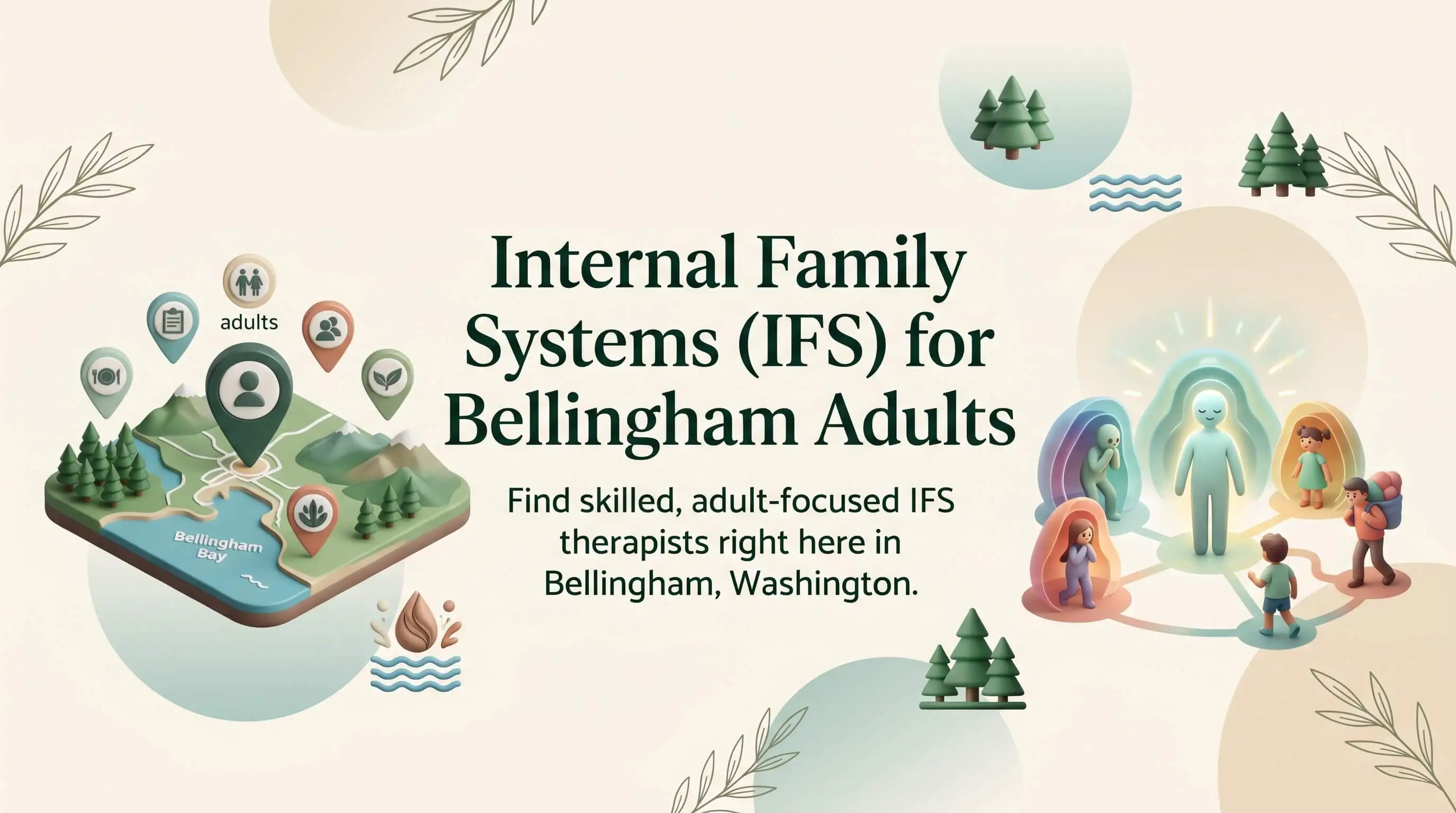
IFS, in a sentence: a way of getting to know the different parts of you instead of fighting them. Psychologist Richard Schwartz developed Internal Family Systems on the idea that a mind holds many voices, and each one is trying to help.
Some parts are protected. One keeps you at the job until 8 p.m. so nobody can call you lazy. Another goes quiet and flat the second a conversation with your partner gets close. Underneath them sit younger parts that still carry old hurt or shame, and IFS calls those exiles. At the center is what the model calls Self, the steady, curious part of you that can lead once the others ease off.
You don't argue with a part in IFS, and you don't try to evict it. You get curious about what it's guarding. A therapist for anxiety who uses IFS can help you explore those protective parts with compassion. For a lot of people, that shift is where things start to move.
Who IFS Helps, and Whether It Fits Adult Men
IFS tends to work well for adults carrying:
Trauma and complex PTSD, especially the older, layered kind
Anxiety that keeps you braced when nothing is wrong
Attachment patterns that replay in every relationship
Perfectionism, shame, and the pressure never to slip
The part idea lands for many men because it doesn't treat them as broken. That voice telling you to tough it out probably got you through some hard years. Anger that shows up in half a second is often standing in front of something that hurts. IFS gives you room to see that without anyone wagging a finger.
It won't fit everyone, and that's allowed. If depression, ADHD, or substance use is the main thing you're dealing with, a specialist in that area may serve you better, sometimes alongside IFS. A good therapist will say so on the first call.
Finding an IFS Therapist in Bellingham, WA, In Person or Online
Type "IFS therapist Bellingham" into a search bar and you'll mostly get directory profiles. Plenty looks good. A fair number also say waitlist, or not accepting new clients, which is a rough thing to read right after you finally decide to call someone.
Online sessions open the door wider. Any therapist licensed in Washington can see you by secure video as long as you're physically in the state during the session, whether you're in Fairhaven, Ferndale, Lynden, or a parked car outside the office on a lunch break.
Lauren Rath, MA, LMHC, is one of those options. She's a Washington-licensed counselor trained in IFS through the IFS Institute, and she works with adults as an online IFS therapist in Bellingham, WA, focusing on trauma, anxiety, attachment, and perfectionism. She's clear that there's no Bellingham office. Sessions happen by video, so you skip the drive and the waiting room. She's in-network with BCBS, Aetna, Regence, Premera, and Cigna, and the first step is a free 15-minute call.
Whoever you pick, check the license first. The Washington State Department of Health lets you look up any provider by name in about a minute.
Why So Many Men Wait
There isn't one reason. Some men grew up keeping problems inside the house. Some have good reason to distrust a healthcare system that hasn't always treated Black patients fairly, a gap this site has written about in how racism affects trust in healthcare. And some just can't picture what therapy would look like, so starting feels harder than staying put.
If booking a therapist feels like too big a step today, try the NAMI HelpLine first. The National Alliance on Mental Illness runs it as a free peer-support line, and the people who answer can talk through questions and point you toward local help. While it isn't a crisis line, it's a good place to say things out loud before you decide anything.
"The part that walks in first is almost never the part that's hurting. It's the one that stays busy, stays in control, or says everything's fine. I don't push past it. Once we get curious about what it's protecting, it usually loosens up on its own, and the deeper work starts from there. My clients set the pace, and going slowly is part of how this works. For a lot of people, doing that from their own couch over video makes it a little easier to say the hard thing."
7 Essential Resources
Learn where IFS comes from. The IFS Institute is the organization behind the model, and its homepage lays out how it thinks about parts and Self. Source: IFS Institute
Check that your therapist is actually licensed. Search any Washington provider by name or credential number and see their status and any public discipline. Source: Washington State Department of Health Provider Credential Search
Talk it through before you book. Free peer support and referrals, weekdays 10 a.m. to 10 p.m. ET at 800-950-6264. Source: NAMI HelpLine
Get help right now. Call or text 988, or chat online, any hour. It's free and confidential. Source: 988 Suicide and Crisis Lifeline
Find treatment for mental health or substance use. A confidential referral line that never closes, at 1-800-662-4357. Source: SAMHSA National Helpline
Know what to ask a new therapist. A plain-language guide to how therapy works and the questions worth bringing to a first call. Source: NIMH: Psychotherapies
Get ready for a video session. What virtual care costs, how scheduling works, and what equipment you'll need. Source: Telehealth. HHS.gov: For Patients
3 Statistics
You're far from the only one. In 2022, an estimated 59.3 million U.S. adults had a mental illness, which works out to 23.1 percent of all adults. Source: NIMH
Men reach out less. Of adults with a mental illness that year, 41.6 percent of men got treatment, compared with 56.9 percent of women. Source: NIMH
The gap is wider for Black adults. In 2024, Black and African American adults were 36 percent less likely than U.S. adults overall to have received mental health treatment in the past year. Source: HHS Office of Minority Health
Mental illness affects millions of U.S. adults, yet access to treatment remains uneven. In 2022, only 41.6% of men with mental illness received care, compared with 56.9% of women. Black adults also face significant hеаlth dіspаrіtіеs, with lower rates of mental health treatment. These gaps highlight the importance of improving access to qualified therapists, including those offering IFS therapy, and making mental health support more accessible to underserved communities.
Final Thoughts and Opinion
Here's my honest view. IFS is one of the better fits for men who are worn out from fighting themselves, because it starts from respect. Instead of tearing down the parts that got you this far, it listens to them, and most people find that easier to sit with than a list of what's wrong with them.
In Bellingham, the harder problem is usually getting in the door. Waitlists, the drive, and squeezing a weekly session into a workday stop a lot of people before the first appointment. Seeing a Washington-licensed therapist online clears most of that away.
So if you keep searching for an IFS therapist in Bellingham, WA, and keep reading "not accepting new clients," widen the search. Look at licensed online providers, run their name through the state's credential search, and use a free consultation to find out whether the fit feels right.
Frequently Asked Questions
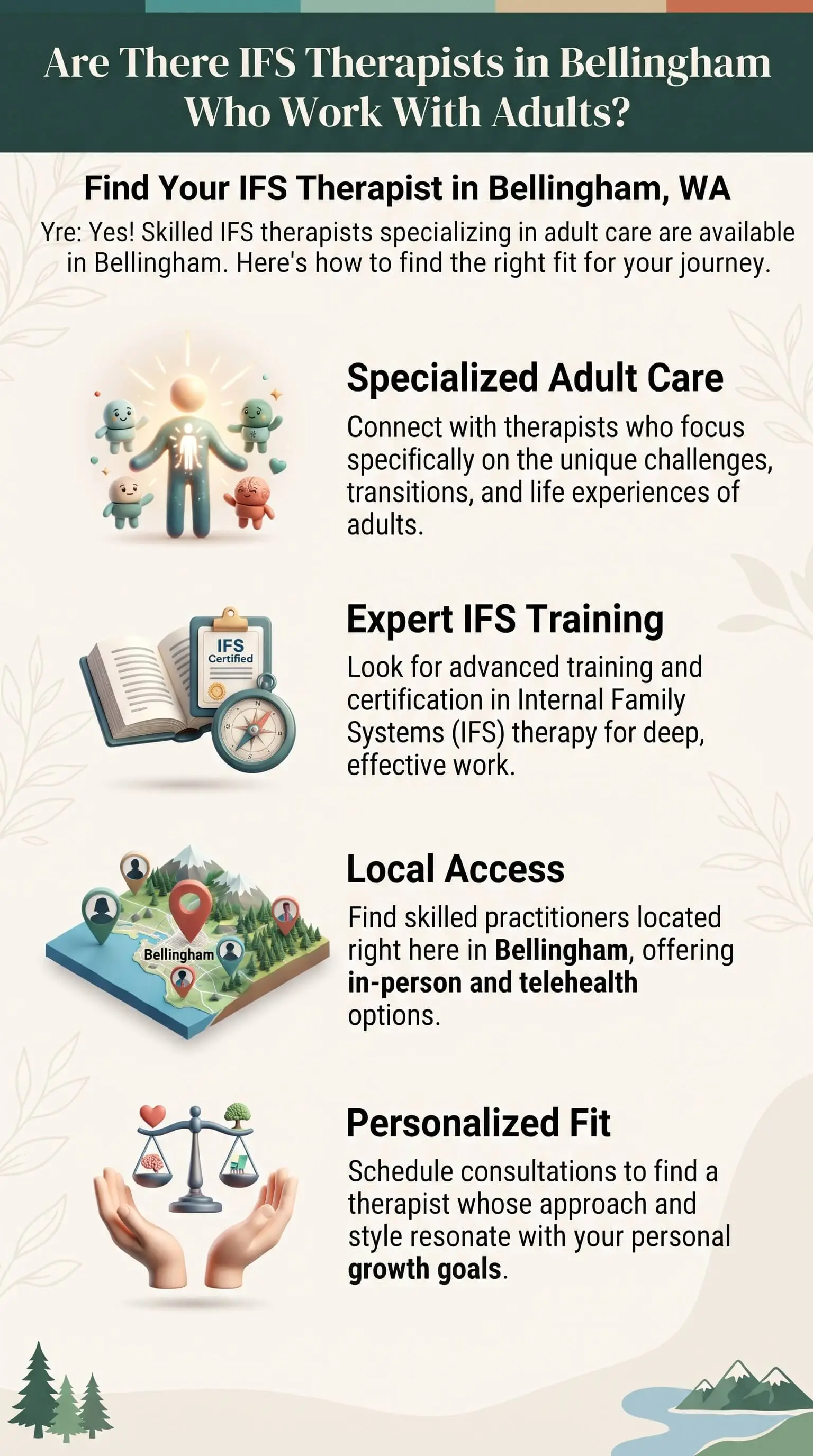
Q: Are there IFS therapists in Bellingham who work with adults?
A: Yes. Several Bellingham clinicians list Internal Family Systems among their approaches, though some keep waitlists. Washington-licensed therapists can also see Bellingham and Whatcom County adults online. Lauren Rath, MA, LMHC, offers IFS therapy for adults by secure video and is currently accepting new clients.
Q: Does online IFS therapy work as well as sitting in an office?
A: For many adults, yes. IFS is a talk-based therapy, so being in the same room isn't what makes it work. Plenty of people open up more easily from their own couch. The bigger factor is whether you trust the therapist and feel the pace is yours.
Q: Will insurance cover IFS therapy in Washington?
A: Often. Insurers generally cover therapy based on the provider's license and your diagnosis, not the specific method. Lauren Rath Therapy is in-network with BCBS, Aetna, Regence, Premera, and Cigna. Call your plan to confirm your mental health benefits and copay.
Q: How many IFS sessions will I need?
A: Nobody can give you an honest fixed number. Some people notice a shift in the first few sessions, while older or more layered experiences take longer. If it takes a while, that isn't failure. You set the pace, and a good therapist checks in with you along the way.
Q: How do I check that a Bellingham therapist is licensed?
A: Use the Washington State Department of Health's Provider Credential Search. Type in the therapist's name or credential number to see their license type, status, and any public disciplinary actions. It takes about a minute and works for anyone, including the therapist mentioned here.
Q: What should I do if I'm in crisis right now?
A: Call or text 988 to reach the 988 Suicide and Crisis Lifeline, any hour of the day. If you're in immediate danger, call 911. Outpatient therapists, IFS therapists included, are not crisis services.
Book a Free Consult
Starting is a fifteen-minute call, and you don't need to have the words lined up. If you're an adult in Bellingham or anywhere in Whatcom County, book a free consultation with Lauren Rath Therapy and see whether IFS feels like a fit, with no forms and no obligation. If you'd rather talk to someone first, the NAMI HelpLine is there for that.